Über das Knorr Labor
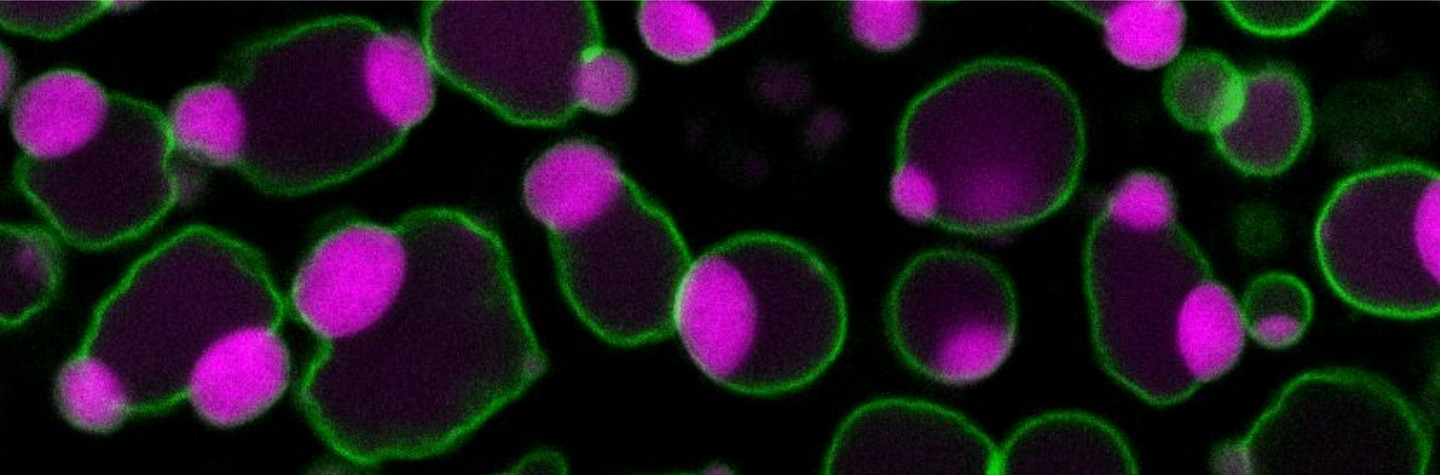
Wie entstehen Organellen in Zellen? Dieser Frage geht unsere DFG-geförderte Emmy Noether-Gruppe „Interfacial Cell Biology“ im Rahmen der Professur für Biochemie und Molekularbiologie an der Medizinischen Fakultät, Universität zu Köln und Uniklinik Köln nach.
Wir konzentrieren uns insbesondere auf strukturbildene, physiologische Prozesse, die durch Kontakte zwischen neu entstehenden flüssigen Kompartimenten (auch bekannt als biomolekulare Kondensate, membranlose Organellen oder Tröpfchen) und herkömmlichen zellulären Strukturen vermittelt werden, z.B. membrangebundene Organellen. Unser Ziel ist es, ein genaues physikalisch-molekularen Wissen über die zugrundeliegende Kondensat-Substrat-Wechselwirkung zu erlangen, das uns dann eine präzise Beeinflussung zellulärer Prozesse bei medizinischen Anwendungen sowie in der Grundlagenforschung ermöglicht. Die AG „Interfacial Cell Biology“ konzentriert sich auf folgende Schlüsselbereiche:
Autophagie: Das Autophagosom ist die organellare Kernkomponente der Autophagie, eines hochgradig konservierten intrazellulären Abbauprozesses. Während der Autophagie isolieren autophagosomale Membranen intrazelluläres Material, die dann zum Abbau und zur molekularen Wiederverwertung an das Lysosom bzw. die Vakuole weitergereicht wird. Kürzlich entdeckten wir, dass phasengetrennte Kondensate die Bildung von Autophagosomen über Benetzungsinteraktionen vermitteln. Dieser komplexe Mechanismus wird durch die physikalischen Eigenschaften von der molekularen Identität von Kondensaten und Membranen gesteuert und resultiert in der Isolation von unterschiedlichem Recyclingmaterial und zu verschiedenen Morphologien von Autophagosomen (Nature 2020, Nature 2021, Autophagy 2021). Diese Entdeckungen zeigten zum ersten Mal, dass Kapillarkräfte für unser Verständnis von zellphysiologischen Prozessen essentiell sind.
Embryogenese: Eiweiße, die der menschlichen und tierischen Ernährung dienen, stammen mehrheitlich aus Pflanzensamen, wie zum Beispiel Soja und Weizen. Während der Samenentwicklung sammeln Samen Eiweiße in speziellen Organellen an, die als Eiweißspeichervakuolen bezeichnet werden. Kürzlich entdeckten wir, dass sich in bestimmten Stadien der Embryonalentwicklung im Inneren von ‚normalen‘ Vakuolen mikrometergroße, flüssige Kondensate durch Phasentrennung bilden. Diese Kondensate enthalten Speichereiweiße, benetzen und verformen die umschließende Vakuolenmembran durch Kapillarkräfte, um schließlich die Bildung mehrerer Eiweißspeichervakuolen zu vermitteln (PNAS 2021, JCB 2021).
Unsere Gruppe verfolgt einen hoch kooperativen, iterativen Ansatz und setzt ein breites Spektrum an Methoden ein. Dieses reicht von der Zellbiologie und Biochemie über die mathematische Modellierung bis hin zur Biophysik, den Grenzflächenwissenschaften sowie der synthetischen Biologie. Auf der Grundlage der physiologischen Relevanz von in vivo-Daten wird unser vielseitiger Ansatz grundlegende Erkenntnisse über die physikalisch-molekularen Mechanismen liefern, die Phasenverhalten mit strukturbildenen Prozessen in Zellen verbinden.
(Keywords: Membranbiegung, Membranumbau, Membranformung, Phasentrennung, LLPS, biomolekulare Kondensaten, Benetzung, Kapillarität, Kapillarkraft)